

Deep Draw Components
At Kalyros Engineering LLP, we specialize in the precision manufacturing of high-quality deep draw components, delivering innovative solutions to meet the diverse needs of industries worldwide. As an ISO 9001:2015 certified company, we are committed to excellence, ensuring that every component we produce adheres to the highest standards of quality, reliability, and performance. With our advanced manufacturing capabilities and customer-centric approach, we provide tailored deep draw solutions that drive efficiency and success for your projects.
What Are Deep Draw Components?
Seamless 3D Formation
Deep drawing transforms a flat sheet of metal, known as a blank, into a seamless hollow three-dimensional component.
Precision Components
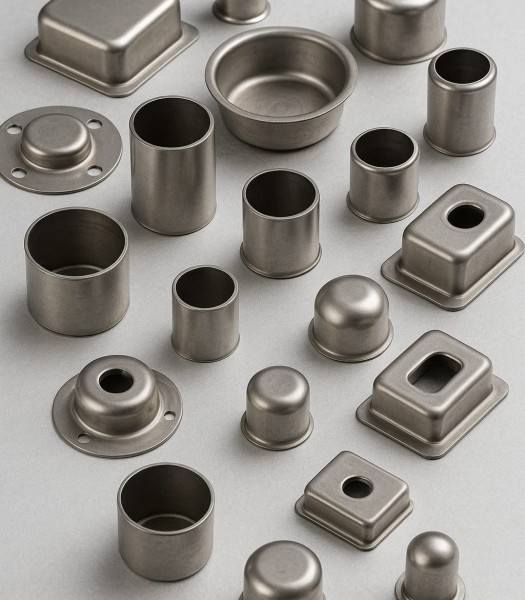
The process enables production of cylindrical, box-shaped and complex components with high dimensional accuracy.
High Structural Integrity
Deep drawn components provide strong and durable structures suitable for demanding industrial applications.
Minimal Material Waste
Deep drawing offers efficient material utilization, making it suitable for high-volume precision manufacturing.
The Deep Drawing Process: How We Make It Happen
Material Selection and Preparation
High-quality metal blanks are selected according to component requirements. The blank is cleaned and lubricated to ensure smooth forming and prevent defects.
Blank Placement
The metal blank is positioned in a deep drawing press over a die that defines the required component shape.
Drawing Operation
A punch applies controlled force to draw the blank into the die. Multiple drawing stages may be used to achieve the required depth and complexity.
Trimming and Finishing
Excess material is trimmed and additional processes such as polishing, deburring, coating, plating or anodizing may be applied.
Quality Inspection
Components undergo inspection for dimensional accuracy, surface quality and compliance with customer specifications.
ISO 9001:2015 Quality System
Our quality management system supports traceability, consistency and controlled production throughout the manufacturing process.
Materials Used in Deep Draw Components
Kalyros Engineering LLP works with a wide range of materials selected according to strength, corrosion resistance, formability, performance and application requirements.
Types and Grades of Deep Draw Components
Cylindrical Components
Cups, cans and tubes used in containers, filters and housings.
Box-Shaped Components
Rectangular or square enclosures used for electronics, appliances and industrial equipment.
Complex Geometries
Custom shapes with intricate features including stepped or tapered designs for specialized applications.
Seamless Components
Parts manufactured without welds or joints for strength and leak-proof performance.
Material Grades
Uses and Applications of Deep Draw Components
Automotive Industry
Aerospace and Defense
Medical Devices
Electronics
Consumer Goods
Industrial Equipment
Energy Sector
Automotive Industry
Fuel tanks, exhaust components, battery casings and sensor housings.
Aerospace and Defense
Lightweight enclosures, missile casings and structural components requiring high strength and precision.
Medical Devices
Surgical instrument casings, implantable device components and sterilization containers.
Electronics
Enclosures for circuit boards, battery cases and connectors.
Consumer Goods
Kitchenware, beverage cans and cosmetic containers.
Industrial Equipment
Filters, pressure vessels and pump housings.
Energy Sector
Components for solar panels, wind turbines and oil and gas equipment.
Why Choose Kalyros Engineering LLP?
Our Commitment to ISO 9001:2015 Standards
At Kalyros Engineering LLP, quality is at the core of everything we do. Our ISO 9001:2015 certification reflects our dedication to maintaining a robust quality management system (QMS) that ensures consistent product quality, customer satisfaction and continuous improvement.
Customer Focus
Delivering components that meet customer specifications and enhance product performance.
Process Optimization
Streamlining production for efficiency, precision and cost-effectiveness.
Risk Management
Proactively identifying and mitigating risks to ensure reliable outcomes.
Continual Improvement
Regularly evaluating and improving processes to maintain high industry standards.