
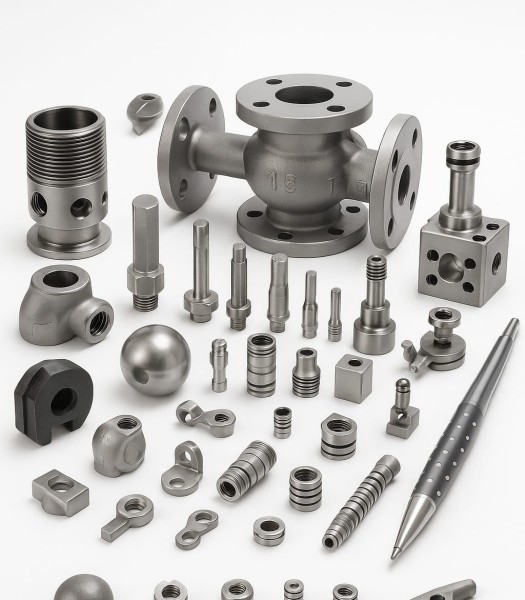
Valve Components
At Kalyros Engineering LLP, we specialize in the design, manufacture, and supply of high-quality valve components that power critical applications across industries. Our valve components are engineered with precision, durability, and performance in mind, ensuring seamless operation in the most demanding environments.
What Are Valve Components?
Flow Control Components
Valve components are individual parts that make up a valve, a mechanical device used to control the flow, pressure, or direction of liquids, gases, and slurries.
Reliable Operation
Components work together to regulate flow, prevent leaks, and maintain system integrity under varying pressure, temperature, and environmental conditions.
Industrial Applications
Valve components are essential in oil and gas, petrochemical, water treatment, power generation, pharmaceutical, manufacturing, and other industries.
Industry Standards
Components are designed to meet stringent standards such as API, ASME, ISO, and ANSI.
Key Valve Components
Body
The main structure of the valve that houses internal components, provides the primary pressure boundary, and connects to the piping system.
Bonnet
The cover that seals the valve body and provides access to internal components for maintenance.
Stem
Connects the actuator or handle to the flow control element and transmits motion to open or close the valve.
Disc / Plug / Ball
Controls flow by opening, closing, or throttling the passage through the valve.
Seat
Provides the sealing surface where the disc, ball, or plug makes contact to stop fluid flow.
Trim
Refers to internal components such as the stem, disc, and seat that directly interact with the fluid.
Actuator
Operates the valve manually, pneumatically, hydraulically, or electrically.
Packing, Gaskets & Seals
Prevent leakage around the stem and between the valve body and bonnet.
Yoke
Supports the actuator and stem and is commonly used in gate and globe valves.
Bolts & Fasteners
High-strength components used to assemble the valve body, bonnet, and other parts.
Springs
Used in check valves and pressure relief valves to ensure proper operation and closure.
Bearings & Bushings
Reduce friction and wear in moving parts such as stems and actuators.
How Are Valve Components Made?
Material Selection
High-grade raw materials are selected according to fluid compatibility, pressure, temperature, and application requirements.
Forging & Casting
Components such as valve bodies and bonnets may be forged or cast to achieve the required shape and strength.
Precision Machining
Advanced CNC machines perform turning, milling, drilling, and grinding to achieve precise tolerances.
Surface Treatment
Polishing, coating, and plating processes improve corrosion resistance and component durability.
Heat Treatment
Annealing, quenching, and tempering processes are used to improve hardness and toughness.
Assembly & Testing
Components undergo pressure testing, leak testing, dimensional inspection, and assembly verification.
Quality Assurance
ISO-certified quality processes include NDT methods such as ultrasonic, radiographic, and magnetic particle inspection.
Materials Used in Valve Components
Carbon Steel
ASTM A105, A216 WCB, and A350 LF2 for general-purpose applications with moderate corrosion resistance.
Stainless Steel
Grades 304, 316, 316L, and 410 for corrosion resistance in demanding environments.
Alloy Steel
F11, F22, and F91 grades for high-temperature and high-pressure applications.
Duplex & Super Duplex
Materials selected for superior corrosion resistance, particularly in offshore oil and gas applications.
Brass & Bronze
Used for low-pressure applications such as water and HVAC systems.
Nickel Alloys
Inconel, Monel, and Hastelloy for extreme corrosion resistance in chemical and petrochemical applications.
Titanium
Lightweight and corrosion-resistant material for aerospace and marine applications.
Elastomers & Polymers
PTFE, Viton, and EPDM for seals, gaskets, and O-rings where chemical compatibility is important.
Where Are Valve Components Used?
Oil & Gas
Petrochemical & Chemical
Power Generation
Water & Wastewater
Pharmaceuticals
Food Processing
HVAC & Plumbing
Marine & Shipbuilding
Aerospace & Defense
Mining & Minerals
How Are Valve Components Used?
Body & Bonnet
Form the pressure-containing shell, house internal components, and connect to pipelines.
Stem & Actuator
Transmit motion to open or close the valve manually or through pneumatic, hydraulic, or electric operation.
Disc / Ball / Plug
Moves to regulate flow, allowing full opening, full closure, or controlled throttling.
Seat & Seals
Provide leak-tight sealing when the valve is closed, helping prevent fluid loss or contamination.
Packing & Gaskets
Prevent leakage around the stem and between stationary valve components.
Springs
Used in check valves to ensure automatic closure and prevent backflow.
Why Choose Kalyros Engineering LLP for Valve Components?
Precision Manufacturing
State-of-the-art facilities and skilled engineers ensure components meet exact specifications and tolerances.
Custom Solutions
Customized valve components can be developed according to specific application, material, and design requirements.
Quality Assurance
Components undergo rigorous testing and comply with international standards including API, ASME, ISO, and DIN.
Diverse Material Expertise
Extensive experience with standard materials as well as specialized and exotic alloys.
Global Reach
Valve components are supplied to clients worldwide with a focus on timely delivery and service.
Sustainability
Manufacturing processes prioritize efficiency and environmental responsibility while reducing waste and energy consumption.
Reliable Valve Components for Demanding Applications
Whether you need valve components for high-pressure oil pipelines, corrosive chemical plants, or sanitary pharmaceutical systems, Kalyros Engineering LLP provides precision-engineered solutions designed around application requirements.